christianity and islam both claim divine revelation, fixed texts, and absolute truth. christianity produced secular liberal democracy. islam produced theocratic states that fuse religion and politics. the split comes down to how each text shaped the cultures built around it.
the texts
the bible is two books. the old testament lays out mosaic law and theocratic rule. the new testament pivots. jesus says "render unto caesar what is caesar's," driving a wedge between sacred and secular authority. paul writes letters, not laws.
the gospels were written decades after jesus died, compiled and debated by councils. the source languages, hebrew, aramaic, greek, are dead or scholarly, so every generation translates, interprets, debates. canonization embedded interpretation as a cultural habit.
the quran operates on different terms. muslims hold it as the literal, unaltered word of god, revealed in arabic to muhammad over 23 years. the text covers scripture, law, politics, and social order in a single document.
muhammad was a prophet, statesman, commander, and judge. within his lifetime, islam unified fractured arab tribes. within decades of his death, caliphs expanded across arabia, the levant, persia, egypt. creed and rule were fused from the start.
because arabic is a living language, the text feels immediate to native speakers. interpretation exists, but loose readings risk blasphemy. the structure fosters literalism and unity. it rewards conformity over pluralism.
christianity's collapse
christianity spent most of its history producing empires as fused as any caliphate. the holy roman empire, byzantine empire, spanish inquisition, all blended throne and altar. liberalism came from christianity's collapse, not from its theology.
the reformation shattered religious unity. protestant and catholic wars exhausted europe into tolerating pluralism as a practical necessity.
deists, skeptics, and secular philosophers drove the enlightenment. they argued against church authority and for individual conscience. locke, hobbes, spinoza built liberalism by carving out secular space that christianity had never granted.
the greek philosophical inheritance, aristotle's logic, stoic ethics, sat beneath christianity the whole time, waiting to resurface. translation, debate, and fragmentation created the conditions. the process took centuries and killed millions. nobody planned it.
islam's continuity
islam kept its structural unity. no reformation splintered authority into competing sects forced to coexist.
sunni and shia split early, but within each branch the structure stayed intact: caliphates, sultans, empires where faith and rule remained fused. the ottoman empire lasted until 1922.
no equivalent of the enlightenment secularized philosophy or politics. islamic golden age thinkers, averroes, avicenna, engaged with greek philosophy. their work was suppressed or marginalized within the islamic world, while it fueled the european renaissance.
the result
christianity broke. the fracture made accidental space for secular governance. islam held together. the unity kept faith and politics intertwined.
both texts resist modern liberalism on a plain reading. christianity's culture learned to read around its text over centuries of fragmentation. islam's culture reads within it, reinforced by structural continuity.
the data
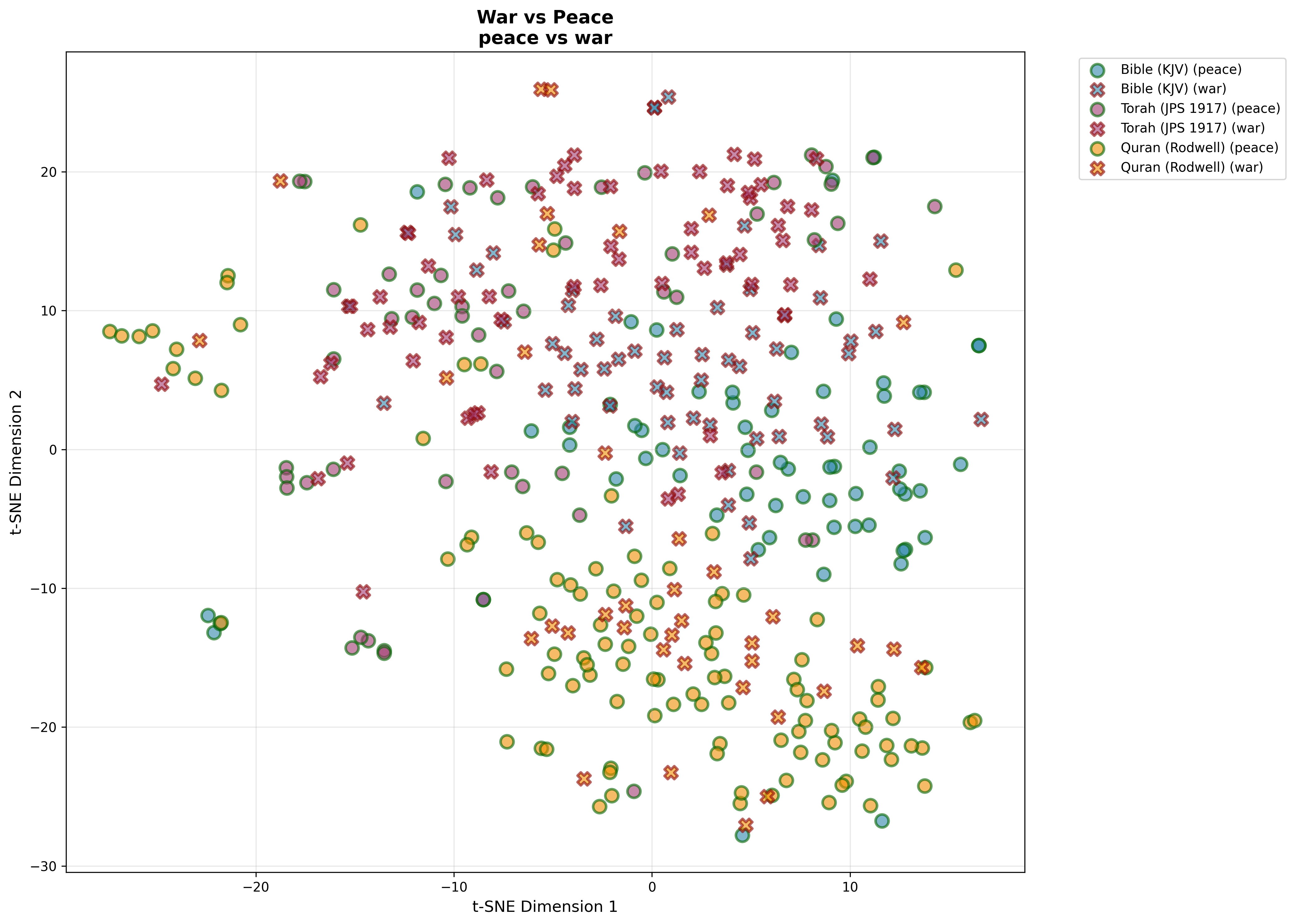
i ran a semantic analysis comparing the bible, torah, and quran. four patterns map onto the divergent political outcomes:
mystical vs legalistic: the quran is most legalistic (41.8% legalistic chunks), the bible most mystical (66.4%). mysticism creates interpretive flexibility. legalism creates rigid application. christianity's mystical bent let it evolve around its text. islam's legal clarity kept it bound to the text.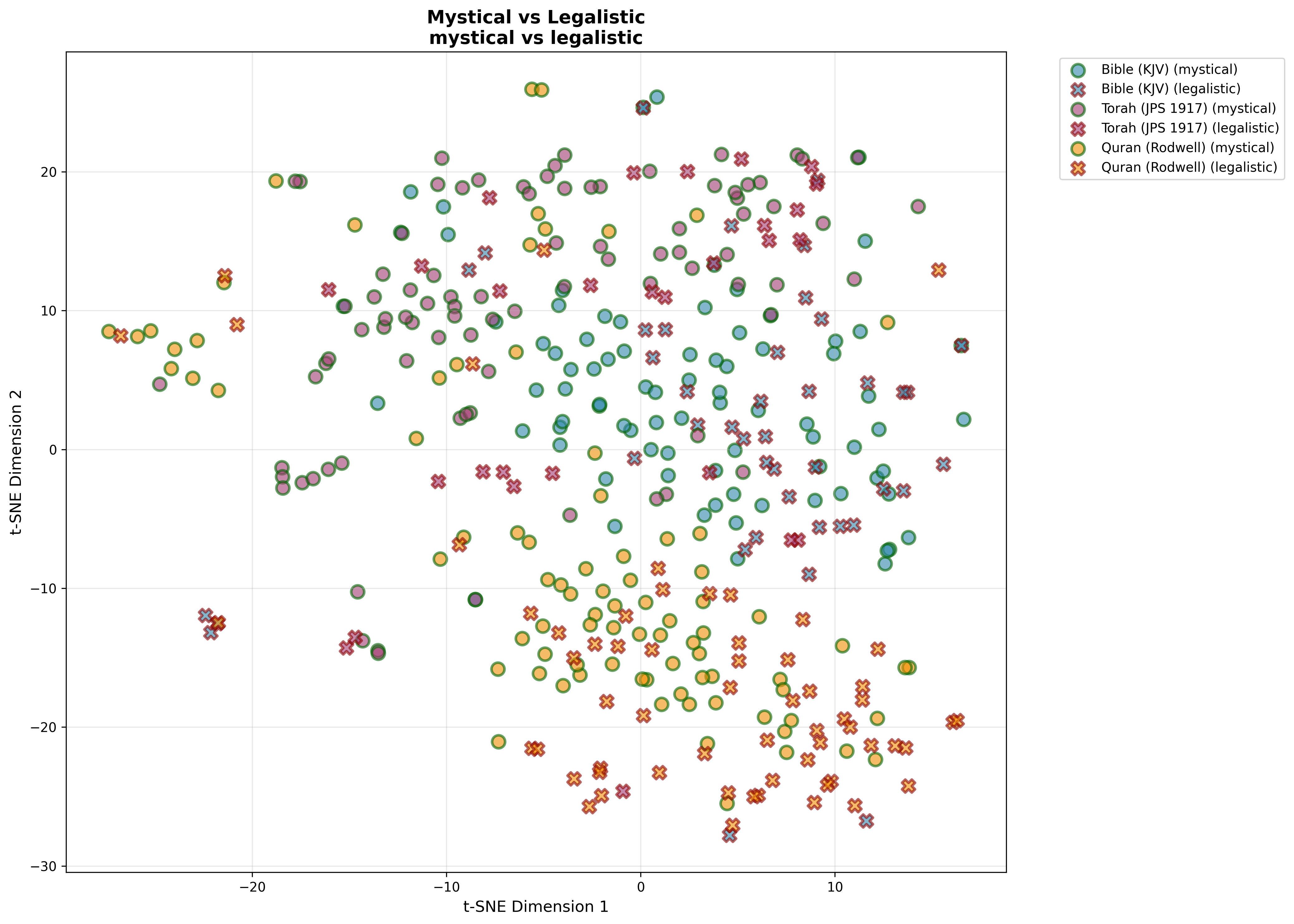 love vs fear: the quran is the only fear-dominant text (64.4% fear vs 35.6% love). the bible leans love (58.4%). fear-based authority maintains orthodoxy and unity. love-based theology tolerates diversity and fracture.
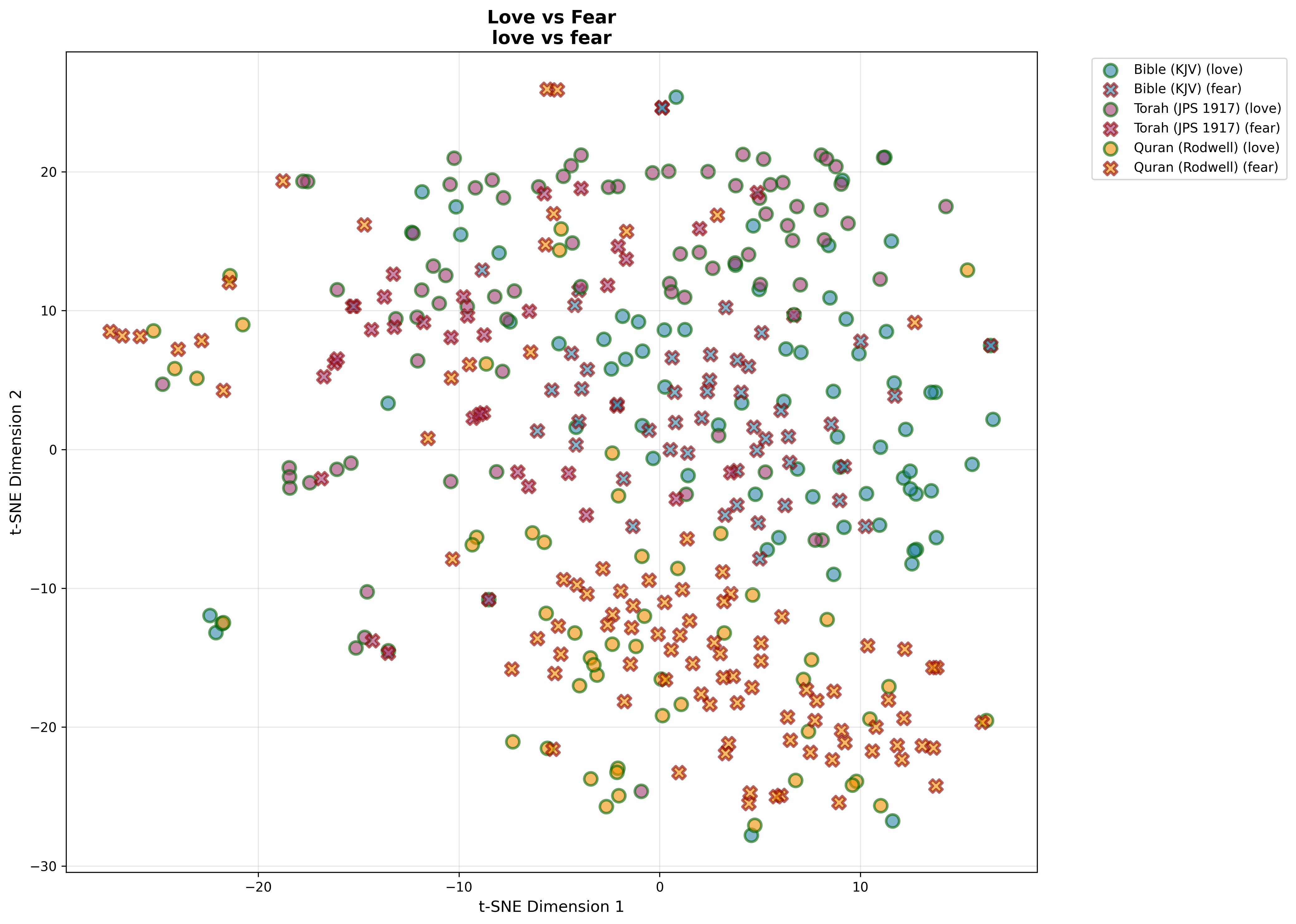 war vs peace: the quran emphasizes peace most (74%), but as unity-through-order. the bible splits 50/50, showing the internal tension that shattered european christendom. that fracture created accidental space for liberalism.
 individualism: the bible scores highest on individual conscience (64.8%), the quran lowest (61.6%). texts emphasizing personal relationship with god over communal obligation produced cultures that could secularize the individual-state relationship.
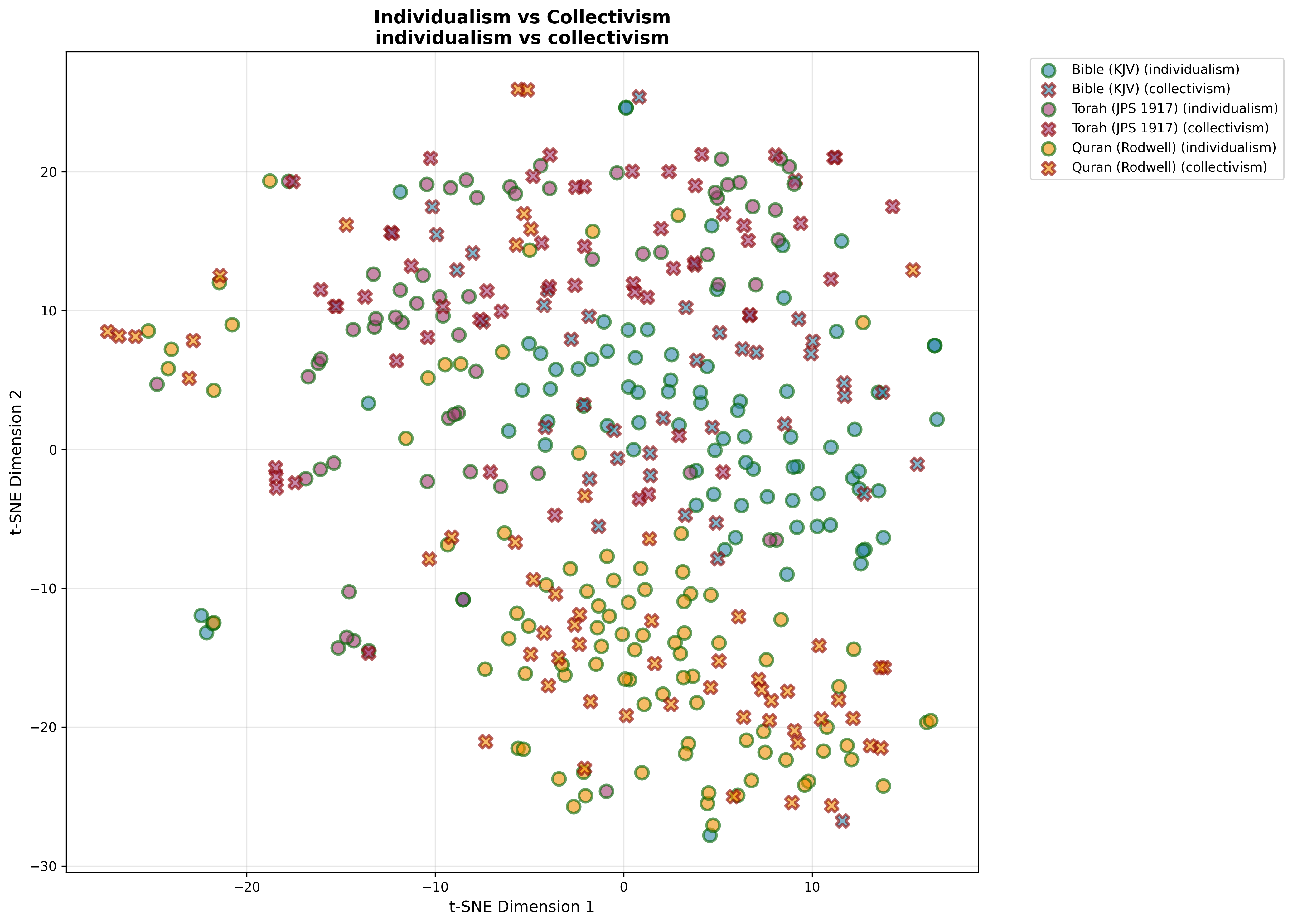
the patterns are measurable in the text itself. the quran's linguistic structure (legalistic, fear-based, unified, moderately collective) maps onto theocratic continuity. the bible's structure (mystical, love-based, internally contradictory, individualistic) maps onto the fragmentation that enabled secular governance.